

Quick Answer
The best whetstone for most home cooks is the Sharp Pebble Complete Whetstone Knife Sharpening System, 1000/6000 Grit — The whetstone most home cooks should start with: a 1000-grit side that resets a dull edge and a 6000-grit side that polishes it razor-keen, plus a bamboo base and angle guide that fix the two mistakes beginners actually make — stone slippage and inconsistent angle. On a tighter budget, the Amazon Basics Double-Sided Whetstone, 1000/6000 Grit with Angle Guide delivers most of the same performance for less.
A whetstone is the sharpest edge your knives will ever have — sharper than new, because factory edges are ground for speed, not keenness. Electric sharpeners are faster and pull-through sharpeners are easier, but the stone is what professionals use because it removes the least metal, works on every knife shape, and produces an edge the other methods can't match. The learning curve is real but shorter than its reputation: most people get a scary-sharp chef's knife within their first three sessions. Here are the whetstones worth buying in 2026, and the technique that makes them work.
How We Picked These
For this whetstone guide, we applied the framework laid out in our Editorial Policy: we evaluate materials and construction first, then weight long-term durability heavily — six-month and one-year owner-review patterns matter more than first-week impressions. We screened out products with documented reliability complaints, missing or hard-to-claim warranty support, and no-name brands without long-term service infrastructure. The picks below are the ones we'd recommend to a friend.
1. Best Overall: Sharp Pebble Complete Whetstone Knife Sharpening System, 1000/6000 Grit
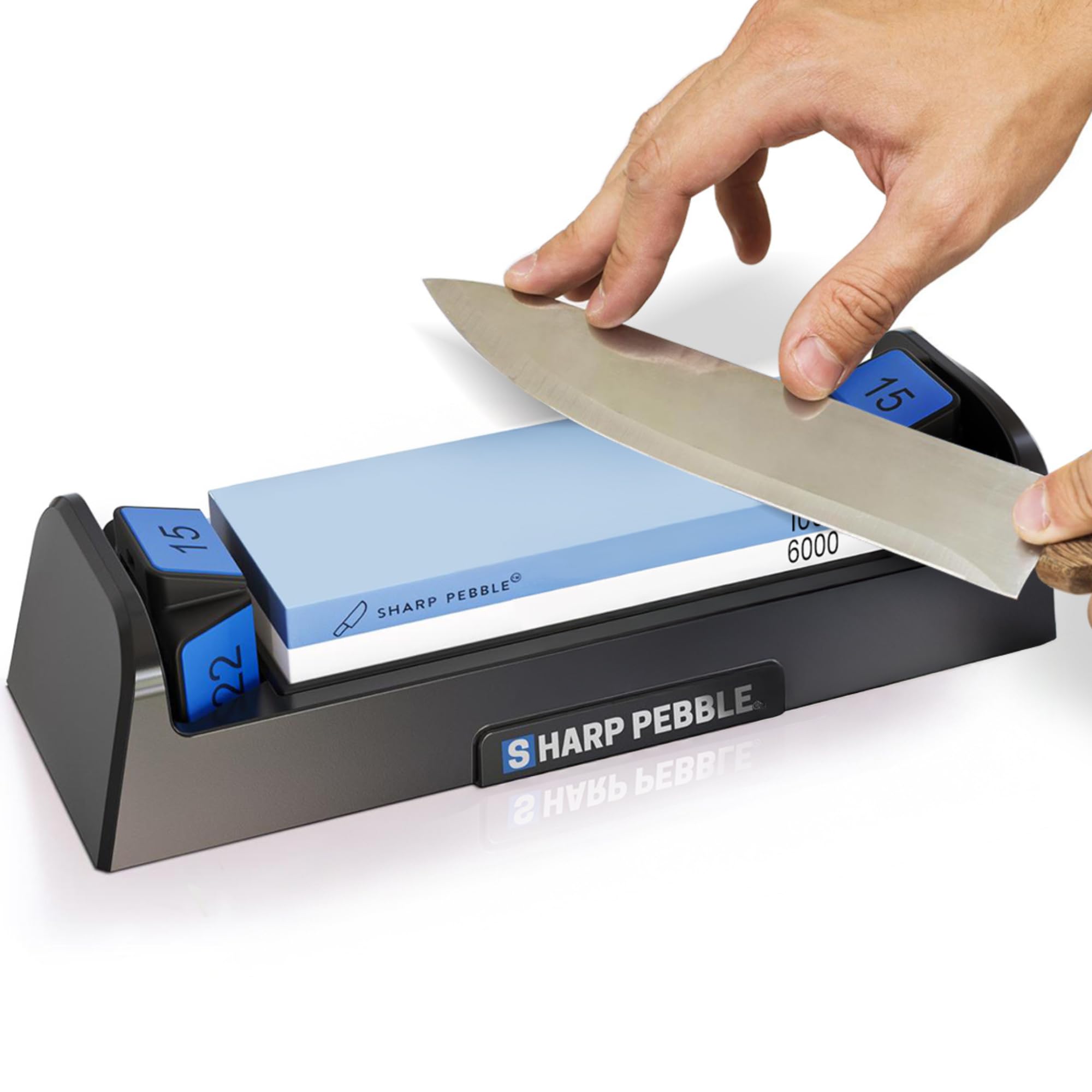
Sharp Pebble Complete Whetstone Knife Sharpening System, 1000/6000 Grit
Sharp Pebble
- 1000/6000 combination covers sharpening and polishing
- Non-slip bamboo base and flattening-friendly water-stone cut
- Angle guide takes the guesswork out of the learning curve
- The category's long-standing bestseller for a reason
Why we picked it: The whetstone most home cooks should start with: a 1000-grit side that resets a dull edge and a 6000-grit side that polishes it razor-keen, plus a bamboo base and angle guide that fix the two mistakes beginners actually make — stone slippage and inconsistent angle.
2. Best Value: Amazon Basics Double-Sided Whetstone, 1000/6000 Grit with Angle Guide

Amazon Basics Double-Sided Whetstone, 1000/6000 Grit with Angle Guide
Amazon Basics
- Genuine two-grit water stone at an entry price
- Includes non-slip base and angle guide
- Perfect 'find out if I like stone sharpening' buy
- Wears faster than premium stones — the honest trade-off
Why we picked it: The same 1000/6000 water-stone formula at the lowest price that still works. It wears a touch faster than premium stones and the base is simpler, but the edge it puts on a chef's knife is indistinguishable for most cooks.
3. Best Premium: Sharp Pebble Extra-Large 3-Stone Kit, 400/1000/6000 Grit

Sharp Pebble Extra-Large 3-Stone Kit, 400/1000/6000 Grit
Sharp Pebble
- 400 grit handles chip repair and truly dead edges
- Extra-large stones fit 10-inch blades comfortably
- Three grits = a complete sharpening progression
- The kit for maintaining a whole knife block
Why we picked it: Adds the 400-grit stone the two-sided kits lack — the coarse stone that repairs chips and revives knives that haven't seen maintenance in years — in an extra-large format that sharpens long chef's knives in fewer passes.
The Comparison Table
| Pick | Brand | Product | Key spec |
|---|---|---|---|
| Best Overall | Sharp Pebble | Sharp Pebble Complete Whetstone Knife Sharpening System, 100... | 1000/6000 combination covers sharpening and polishing |
| Best Value | Amazon Basics | Amazon Basics Double-Sided Whetstone, 1000/6000 Grit with An... | Genuine two-grit water stone at an entry price |
| Best Premium | Sharp Pebble | Sharp Pebble Extra-Large 3-Stone Kit, 400/1000/6000 Grit | 400 grit handles chip repair and truly dead edges |
What to Look For
1000/6000 grit covers 90% of kitchen sharpening. The 1000-grit side does the actual sharpening — raising a fresh edge on a dull knife — and the 6000-grit side refines it to polished, paper-slicing keenness. You only need coarser (400-ish) for damaged edges and chip repair, which is what separates the premium 3-stone kits from the standard combination stones.
Water stones beat oil stones for kitchens. Every pick here is a water stone: soak 10 minutes, sharpen, rinse. Oil stones cut slower, and nobody wants honing oil near a cutting board. The included non-slip base matters more than it sounds — a stone that skates mid-stroke is the top beginner hazard.
Angle consistency beats everything else. A mediocre stone held at a consistent 15-17 degrees out-sharpens a premium stone wobbling between 10 and 25. Angle guides (included with all three picks) feel like training wheels and work like them too: use one for your first sessions, then your hands know the angle forever.
How to use a whetstone: the five-minute version
Soak the stone until bubbles stop (about 10 minutes for these water stones). Set it coarse-side up on its base, and hold the knife at 15-17 degrees — roughly the angle of a matchbook under the spine. Sweep the edge across the stone tip-to-heel with light pressure, as if slicing a thin layer off the stone, five to ten strokes per side, keeping a little water on the surface. You're done with the 1000 side when you can feel a faint burr — a wire-thin lip of metal — along the whole opposite side of the edge. Flip to 6000, repeat with even lighter strokes, and finish by alternating single strokes per side to chase the burr off.
Test on paper: a properly finished edge slices printer paper in a clean curl, no snagging. The whole session takes ten minutes per knife, and a home knife needs it maybe four times a year — our guide to sharpening frequency covers the schedule, and honing between sessions (the steel rod's actual job) stretches the interval further.
Whetstone vs. electric vs. pull-through: an honest comparison
Electric sharpeners (our knife sharpener roundup covers the best ones) win on speed and consistency — guided slots make user error nearly impossible, and a fully dead knife comes back in two minutes. Their costs: they remove noticeably more metal per session (a knife sharpened electrically for years visibly shrinks), the preset angles may not match Japanese blades, and the edge tops out at 'very good.' Pull-through manual sharpeners are the convenience-store option: fine for cheap knives, too aggressive and too crude for anything you care about.
The whetstone inverts all of that: minimum metal removal, any angle you choose (15 degrees for Japanese knives, 17-20 for German — see our chef's knife guide for why they differ), and the highest edge ceiling, at the cost of ten minutes and a small skill. The practical answer for many kitchens is both: an electric for the beat-up utility knives, the stone for the chef's knife and Japanese blades you actually love. Either way, store knives so the fresh edge survives — our knife storage guide has the options.
Buyer Scenario Decision Matrix
Stop comparing specs. Start with what you're actually doing, then the right product is obvious:
| Your Situation | Buy This | Skip This | Why |
|---|---|---|---|
| Most people — daily use, no compromises | Sharp Pebble Complete Whetstone Knife Sharpening System, 1000/6000 Grit | Premium-only sets you won't grow into | 1000/6000 combination covers sharpening and polishing |
| Budget-conscious or first-time buyer | Amazon Basics Double-Sided Whetstone, 1000/6000 Grit with Angle Guide | Premium upgrade you may not need yet | Genuine two-grit water stone at an entry price |
| Heavy daily use, splurge, or buy-once-keep-forever | Sharp Pebble Extra-Large 3-Stone Kit, 400/1000/6000 Grit | Cheaper sets — you'll outgrow them | 400 grit handles chip repair and truly dead edges |
Bottom Line: Which Should You Buy?
For most people: the Sharp Pebble Complete Whetstone Knife Sharpening System, 1000/6000 Grit. The whetstone most home cooks should start with: a 1000-grit side that resets a dull edge and a 6000-grit side that polishes it razor-keen, plus a bamboo base and angle guide that fix the two mistakes beginners actually make — stone slippage and inconsistent angle.
On a budget: the Amazon Basics Double-Sided Whetstone, 1000/6000 Grit with Angle Guide. The same 1000/6000 water-stone formula at the lowest price that still works. It wears a touch faster than premium stones and the base is simpler, but the edge it puts on a chef's knife is indistinguishable for most cooks.
Worth the splurge: the Sharp Pebble Extra-Large 3-Stone Kit, 400/1000/6000 Grit. Adds the 400-grit stone the two-sided kits lack — the coarse stone that repairs chips and revives knives that haven't seen maintenance in years — in an extra-large format that sharpens long chef's knives in fewer passes.
Ready to buy?
Jump straight to our top picks on Amazon — prices shown at click-through.
Frequently Asked Questions
What grit whetstone should a beginner buy?
A 1000/6000 combination stone. The 1000 side sharpens, the 6000 side polishes, and together they handle every routine kitchen sharpening job. Add a coarse 400 stone later only if you need to repair chips or revive badly neglected knives.
How do you know what angle to hold the knife on a whetstone?
15-17 degrees works for almost every kitchen knife — about the height of a matchbook under the spine. Use the included angle guide for your first few sessions; consistency matters far more than the exact number.
Do you use water or oil on a whetstone?
These are water stones: soak 10 minutes before use and keep the surface wet while sharpening. Never use oil on a water stone — it clogs the pores permanently. Rinse and air-dry fully before storing.
Is a whetstone better than an electric knife sharpener?
For edge quality and metal preservation, yes; for speed and zero learning curve, no. Stones produce the sharpest edge and extend knife lifespan; electrics win busy kitchens. Many households sensibly run both.
What is the top-rated whetstone for 2026?
Our top-rated pick is the Sharp Pebble Complete Whetstone Knife Sharpening System, 1000/6000 Grit. The whetstone most home cooks should start with: a 1000-grit side that resets a dull edge and a 6000-grit side that polishes it razor-keen, plus a bamboo base and angle guide that fix the two mistakes beginners actually make — stone slippage and inconsistent angle.
Which whetstone is best for beginners or a tighter budget?
The best-rated value pick is the Amazon Basics Double-Sided Whetstone, 1000/6000 Grit with Angle Guide — The same 1000/6000 water-stone formula at the lowest price that still works. It wears a touch faster than premium stones and the base is simpler, but the edge it puts on a chef's knife is indistinguishable for most cooks.
What is the best whetstone for beginners?
A 1000/6000-grit water stone with a non-slip base and angle guide — the Sharp Pebble system is the standard pick. That combination sharpens and polishes every kitchen knife, and the guide flattens the learning curve to two or three sessions.
How often should you flatten a whetstone?
Water stones dish in the middle with use — check every 5-10 sessions with a straightedge, and flatten with a lapping plate or coarse flattening stone when you see a gap. A dished stone rocks the blade and ruins angle consistency.
Want to dig deeper? See our guides to Best Knife Sharpener (2026), How Often Should You Sharpen Knives?, and How to Store Kitchen Knives Safely.