

Quick Answer
The best mortar and pestle for most home cooks is the ChefSofi Marble Mortar and Pestle Set 6" — Heavy marble 6-inch set — smooth interior perfect for pesto, herbs, and spice pastes. On a tighter budget, the IMUSA Small Polished Granite Mortar and Pestle 3.75" delivers most of the same performance for less.
A real mortar and pestle releases essential oils from spices in a way a coffee grinder can't. The trick is picking the right material for what you grind — granite for tough spices, marble for delicate herbs. Here are the three we'd buy.
How We Picked These
For this mortar and pestle guide, we applied the framework laid out in our Editorial Policy: we evaluate materials and construction first, then weight long-term durability heavily — six-month and one-year owner-review patterns matter more than first-week impressions. We screened out products with documented reliability complaints, missing or hard-to-claim warranty support, and no-name brands without long-term service infrastructure. The picks below are the ones we'd recommend to a friend.
1. Best Overall: ChefSofi Marble Mortar and Pestle Set 6"
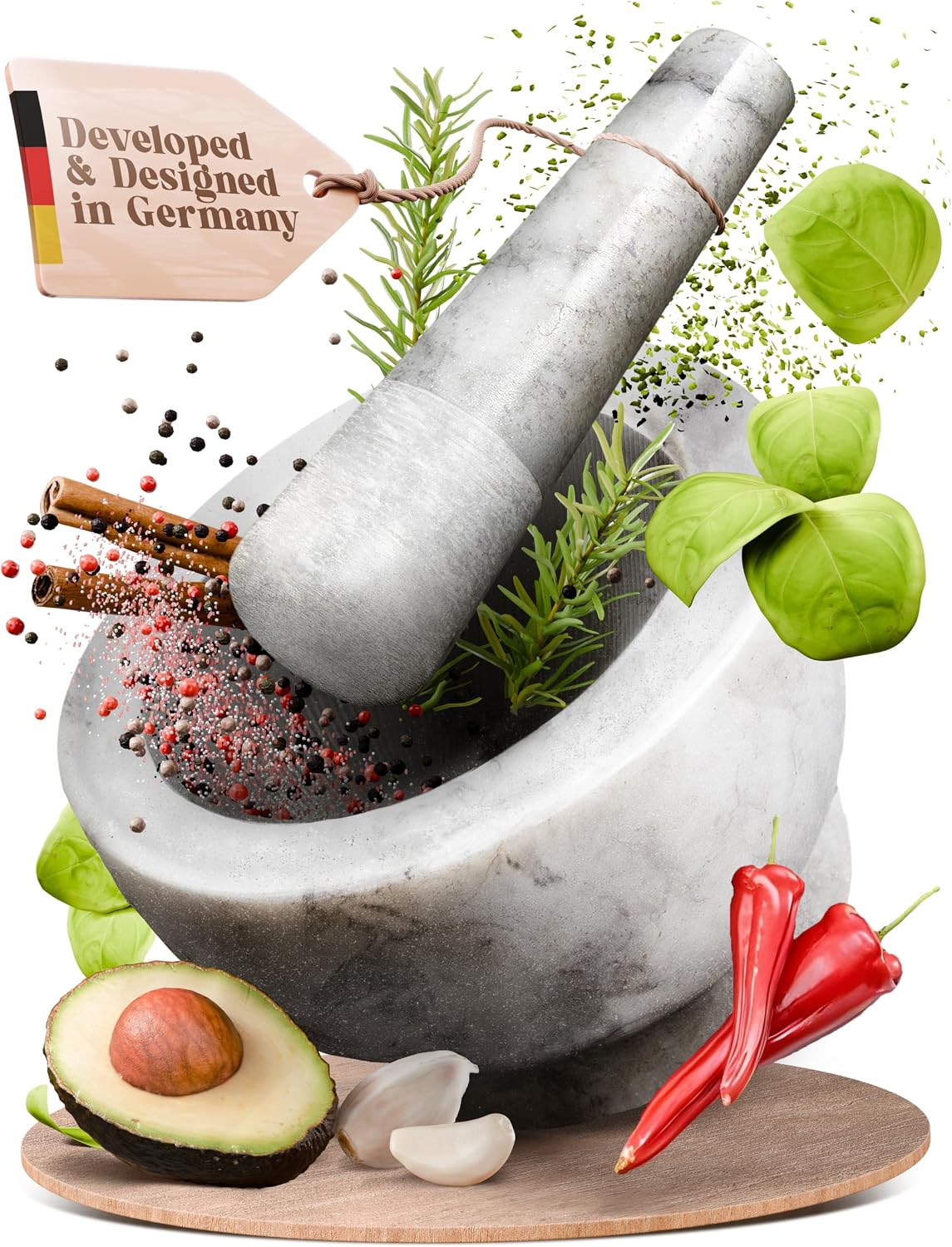
ChefSofi Marble Mortar and Pestle Set 6"
ChefSofi
- 6-inch capacity
- Heavy marble construction
- Smooth interior
- 1.5 cup capacity
Why we picked it: Heavy marble 6-inch set — smooth interior perfect for pesto, herbs, and spice pastes.
2. Best Value: IMUSA Small Polished Granite Mortar and Pestle 3.75"

IMUSA Small Polished Granite Mortar and Pestle 3.75"
IMUSA
- 3.75" compact size
- Polished granite
- Budget-friendly
- Heavy enough to stay put
Why we picked it: IMUSA's compact granite mortar — perfect for small-batch spice grinding and herb pastes.
3. Best Premium: ChefSofi Mortar and Pestle Set 6" - 2 Cup Unpolished

ChefSofi Mortar and Pestle Set 6" - 2 Cup Unpolished
ChefSofi
- Unpolished granite (better grinding)
- 6-inch capacity
- 2 cup capacity
- Heavy stable design
Why we picked it: ChefSofi's unpolished granite — rougher interior grinds tough peppercorns and whole spices.
The Comparison Table
| Pick | Brand | Product | Key spec |
|---|---|---|---|
| Best Overall | ChefSofi | ChefSofi Marble Mortar and Pestle Set 6" | 6-inch capacity |
| Best Value | IMUSA | IMUSA Small Polished Granite Mortar and Pestle 3.75" | 3.75" compact size |
| Best Premium | ChefSofi | ChefSofi Mortar and Pestle Set 6" - 2 Cup Unpolished | Unpolished granite (better grinding) |
What to Look For
Material affects use. Granite (IMUSA, HiCoup) has a rough surface that grinds tough peppercorns and dry spices. Marble (ChefSofi) is smoother — better for pesto and herb pastes. Both should be heavy enough to stay put while grinding.
Capacity matters. 2-cup capacity (HiCoup) handles weekly use. 3.5-cup (ChefSofi premium) handles batch pesto and curry pastes. Don't oversize for occasional spice grinding.
Granite, marble, molcajete, suribachi: matching stone to cuisine
The material differences are functional, not aesthetic. Polished granite (the IMUSA pick) is the all-rounder: heavy enough to crush coriander and peppercorns, smooth enough to work wet pastes, non-porous enough to rinse clean of garlic. Marble (the ChefSofi sets) is slightly softer and prettier, excellent for spices and compact enough to live on the counter — its polished bowl just needs a firmer grinding motion since it's less abrasive. The regional designs earn their specialization: a Mexican molcajete's rough basalt tears roasted chiles and tomatoes into salsa with texture a blender destroys, and a Japanese suribachi's ridged ceramic grinds sesame and makes dressings with a fraction of the effort.
What to avoid: small decorative sets under 4 inches (spices ricochet out of shallow bowls — 6-inch/2-cup capacity like the ChefSofi is the working minimum), wooden mortars for anything wet (they absorb garlic forever), and unsealed soft stone that sheds grit. A new granite or basalt mortar needs a one-time seasoning: grind a handful of white rice to powder repeatedly until the powder comes out clean, taking any loose stone dust with it.
Why crushing beats blades — and the technique that proves it
A blade cuts cells cleanly and leaves most aromatic oils inside the pieces; a pestle ruptures cells completely, releasing everything. The difference is obvious in the classics: pesto made in a mortar is visibly creamier and louder-flavored than food-processor pesto because the basil is crushed into emulsion rather than chopped into flecks; a Thai curry paste's aromatics fuse into one perfume instead of remaining separate specks; and garlic worked with a pinch of coarse salt (the salt is your abrasive) becomes a smooth paste that dissolves into dressings — something mincing can never achieve. This is also why toasted whole spices ground in the mortar outperform even the electric spice grinder when texture matters: you control the grind from cracked to powder in real time.
Technique is press-and-twist, not smash: hold the pestle like a dagger, press ingredients against the wall and twist, using strikes only to break hard things initially. Work in small batches, hardest ingredients first (seeds, nuts, garlic), soft leaves and oil last. The mortar also does jobs nobody markets: cracking peppercorns for steak au poivre, bruising lemongrass, crushing crackers, splitting cardamom pods. It's the rare kitchen tool with zero parts, zero power, and a permanent spot within arm's reach — our garlic press and zester guides cover its single-purpose neighbors.
Care, cleaning, and the recipes that justify the counter space
Care is almost nothing, which is the tool's charm: rinse with hot water and a stiff brush immediately after use, no soap on porous stone (granite tolerates a drop; basalt molcajetes and unpolished marble absorb it and return it in your next pesto), and air-dry fully before storing. Garlic and chile ghosts lingering in the stone lift with the rice trick — grind dry rice to powder, discard, repeat — the same move as the initial seasoning. Never dishwasher, never soak wooden pestles, and treat a dropped granite mortar on a tile floor as the safety hazard it is; a folded towel underneath while working protects both counter and downstairs neighbors from the pounding.
The starter recipes that make the tool a habit rather than décor: a weekly garlic-salt-lemon-olive-oil paste that becomes dressing, marinade, and garlic bread in one; toasted cumin-coriander-peppercorn ground fresh for taco night (the upgrade over pre-ground is not subtle — see the spice grinder guide for the electric route when volume demands it); classic basil pesto, hardest ingredients first, oil streamed in last; guacamole started by mashing onion, chile, and salt into paste so the seasoning distributes through the avocado instead of sitting on it; and Thai-style curry paste, the tool's original job description. Each is ten minutes, each is visibly better than its machine version, and together they're why this five-thousand-year-old tool still outsells most gadgets on this site.
Buyer Scenario Decision Matrix
Stop comparing specs. Start with what you're actually doing, then the right product is obvious:
| Your Situation | Buy This | Skip This | Why |
|---|---|---|---|
| Most people — daily use, no compromises | ChefSofi Marble Mortar and Pestle Set 6" | Premium-only sets you won't grow into | 6-inch capacity |
| Budget-conscious or first-time buyer | IMUSA Small Polished Granite Mortar and Pestle 3.75" | Premium upgrade you may not need yet | 3.75" compact size |
| Heavy daily use, splurge, or buy-once-keep-forever | ChefSofi Mortar and Pestle Set 6" - 2 Cup Unpolished | Cheaper sets — you'll outgrow them | Unpolished granite (better grinding) |
Bottom Line: Which Should You Buy?
For most people: the ChefSofi Marble Mortar and Pestle Set 6". Heavy marble 6-inch set — smooth interior perfect for pesto, herbs, and spice pastes.
On a budget: the IMUSA Small Polished Granite Mortar and Pestle 3.75". IMUSA's compact granite mortar — perfect for small-batch spice grinding and herb pastes.
Worth the splurge: the ChefSofi Mortar and Pestle Set 6" - 2 Cup Unpolished. ChefSofi's unpolished granite — rougher interior grinds tough peppercorns and whole spices.
Ready to buy?
Jump straight to our top picks on Amazon — prices shown at click-through.
Frequently Asked Questions
What's the best mortar and pestle?
The ChefSofi Marble — smooth interior for pesto and herbs, 6-inch size, sturdy weight. The HiCoup Granite is the heavier-duty pick for tough spices. IMUSA's polished granite is the budget value.
Granite vs marble mortar and pestle?
Granite has a rougher interior — better for crushing dry spices, peppercorns, salt. Marble is smoother — better for herbs, pesto, garlic pastes. For one tool, granite is more versatile.
What is the top-rated mortar and pestle for 2026?
Our top-rated pick is the ChefSofi Marble Mortar and Pestle Set 6". Heavy marble 6-inch set — smooth interior perfect for pesto, herbs, and spice pastes.
Which mortar and pestle is best for beginners or a tighter budget?
The best-rated value pick is the IMUSA Small Polished Granite Mortar and Pestle 3.75" — IMUSA's compact granite mortar — perfect for small-batch spice grinding and herb pastes.
Granite vs marble mortar and pestle?
Granite has rougher interior — better for crushing dry spices, peppercorns. Marble is smoother — better for herbs, pesto, garlic pastes.
Want to dig deeper? See our guides to Best Spice Rack (2026), Best Tortilla Press (2026), and Best Chef's Knife (2026).